-1-2
EMC
Emissions and immunity, essential performance definition, proximity field testing for devices used near transmitters.
Active devices · IEC 60601
IEC 60601-1 basic safety and essential performance, IEC 60601-1-2 electromagnetic compatibility, and the collateral standards that apply to alarms, home use, emergency use and physiological closed-loop control.
Active medical devices need two independent evidence sets: safety to IEC 60601-1 (shock, leakage current, insulation, thermal, mechanical and abnormal-condition behaviour) and EMC to IEC 60601-1-2 (emissions plus immunity to ESD, RF fields, transients, surges, magnetic fields and supply dips). Both are tested on production-equivalent units in all declared configurations, and both reports are required in CSDT, MDR and 510(k) files.
Scope
| Area | What is checked | Where projects usually fail first |
|---|---|---|
| Electrical hazards | Classification, MOOP/MOPP, creepage and clearance, dielectric strength, leakage current in normal and single-fault conditions | Creepage across a coated PCB, patient-leakage margin on a floating applied part |
| Mechanical & thermal | Enclosure strength, moving parts, surface temperature, excessive temperature in fault conditions | Transformer or motor temperature rise under single fault |
| Hazardous situations | Unintended output, interruption of supply, component failure, software-initiated hazardous conditions | No risk-management traceability from the abnormal-condition test back to the FMEA |
| Construction & marking | Components, wiring, connectors, labels, symbols, accompanying documents | Symbols and language in the IFU not matching the target market |
| Programmable systems | PEMS requirements, software lifecycle link to IEC 62304 | Software version tested differs from the version submitted |
EMC · IEC 60601-1-2
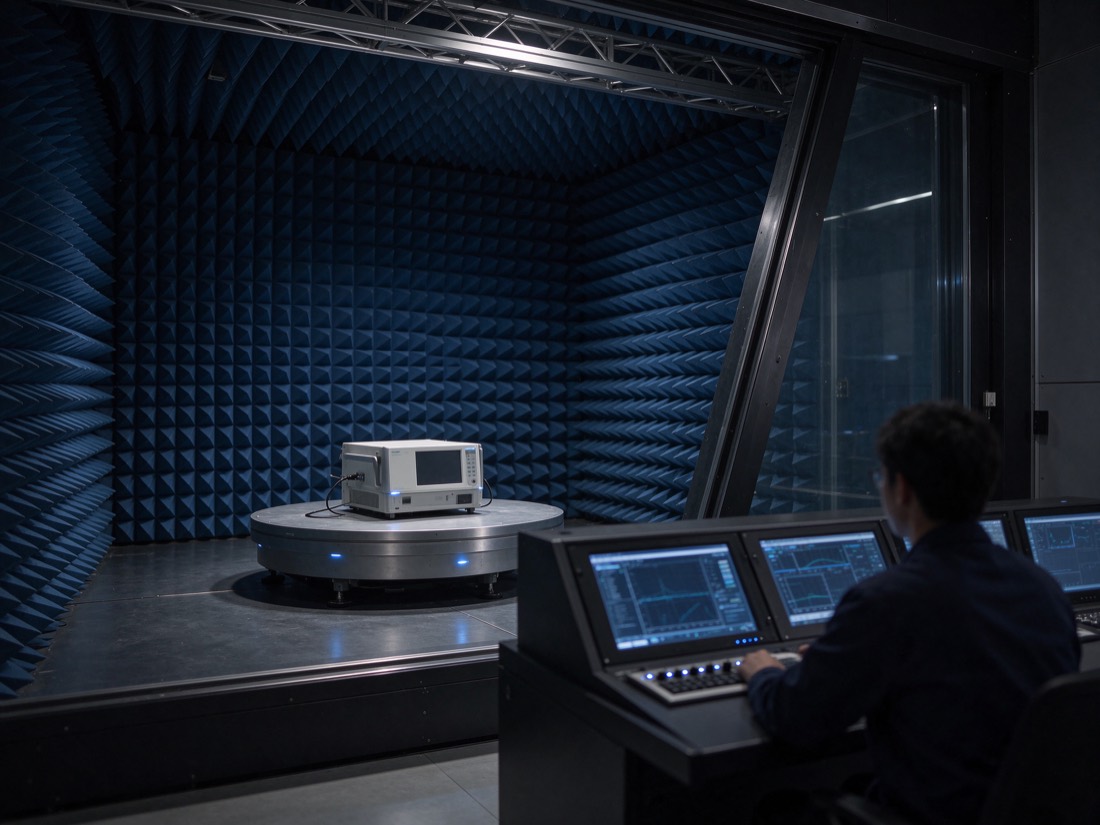
Emissions are usually the easier half. Most EMC failures we see are immunity: a display resetting under ESD, a sensor drifting in a modulated RF field, or a power supply collapsing on a supply dip that the device is expected to ride through.
Collateral & particular standards
Emissions and immunity, essential performance definition, proximity field testing for devices used near transmitters.
Usability engineering file per IEC 62366-1, use-related risk analysis and summative evaluation support.
Alarm conditions, signal characteristics, visual and auditory alarm limits, alarm system documentation.
Home-use environment requirements: enclosure, drop, ingress, temperature and supply variation.
Emergency medical service environments, ruggedness and supply conditions for field deployment.
Climatic and mechanical robustness to the IEC 60068 series, including transport and storage conditions.
FAQ
Usually yes. Battery-powered equipment still emits and is still susceptible. Conducted emission tests may not apply, but radiated emissions and most immunity tests generally do.
Yes, on the same chamber. A pre-scan typically identifies radiated and conducted emission problems and likely immunity failures before the formal slot, so the fix happens in design rather than in a re-test queue.
Generally one to three production units plus all accessories and cables in the intended use. Every declared configuration must be tested or justified as representative — agree the list before booking.
Three to six weeks for one configuration including reporting. Each failure adds a design change, a new unit and a new chamber slot.
Next step
We reply with the applicable clauses, unit count, chamber window and a fixed price.